- Company
- Elevarm
- Role
- Product Designer: flow design across mobile and dashboard, UI, credit scoring questionnaire, settlement logic in the interface, handoff
- Team
- Product Manager, Product Support & Operations, Engineering team
- Stakeholders
- Agri-Project Management, Financing & Finance Ops, Procurement, Traders Ops, and leadership, including the Chief Agriculture Officer
- Timeline
- 2023 – 2026
- Platform
- Elevarm App (Flutter, used mainly on Android by Field Officers) and Elevarm Dashboard (web, used by finance, agri-project management, and leadership)
- Scope
- Agriproject application, document check, credit scoring, multi-level approval, digital contract signing, repayment status, harvest settlement (FPP)
Lending to Farmers With No Credit History
Designing credit scoring, approval, and harvest settlement end-to-end, across a field app and a finance dashboard
Overview
Elevarm finances smallholder farmers through AgriprojectsAgriprojectElevarm's farm financing project. Types include Yarnen, Kemitraan, Ownfarm, and Mertilu.. Instead of cash, a farmer receives seeds, fertilizer, and other farm inputs worth an agreed budget, then settles after harvest. Agriprojects come in several types, such as YarnenYarnen · Bayar PanenThe farmer receives farm inputs on credit and repays from the harvest sold to Elevarm. The farmer carries the farming risk., KemitraanKemitraanElevarm and the farmer share capital and risk, then split the profit by an agreed percentage. (partnership), OwnfarmOwnfarmElevarm's own project. Elevarm carries all capital and risk, and farmers are paid for their work., and MertiluMertiluA profit-sharing type named after mertelu, a traditional Javanese arrangement where the harvest is split into thirds between the landowner and the farmer., but they all follow the same path: plan, apply, assess, approve, sign, plant, harvest, settle.
Before joining Elevarm, 89.5% of farmers financed their season with their own money, and many relied on informal lenders (Impact Report 2024). Financing them responsibly means making credit decisions about people who often have little or no formal credit history.
This case study shows how I designed that path across two products. Field OfficersField Officer (FO)Elevarm staff who work directly with farmers in the field. apply and sign contracts in Elevarm App. Finance, agri-project management, and leadership assess and approve in Elevarm Dashboard. After harvest, the app turns recorded yields into the farmer's final payment, line by line.
Challenge
A financing decision needs the whole farmer
For Field Officers
- An application needs data that already lives elsewhere in the app: the farmer, their plots, the crop plan, and an approved budget (RABRAB · Rencana Anggaran BiayaThe approved budget for farm inputs.). Retyping it is slow and error-prone.
- Officers often work where signal is weak and documents are scattered. An application that fails halfway, or gets rejected for a missing photo days later, wastes a field trip.
For finance, management, and the farmer
- Many farmers have a thin credit history. A credit bureau score alone can't tell whether someone is a good farmer with a reliable buyer.
- Approvals involve several roles, from Procurement to the Chief Agriculture Officer. Without a shared status, nobody knows where an application is stuck.
- At harvest, the farmer's payment depends on loan deductions, harvest value, and profit sharing. If the farmer can't see how the number was reached, they have little reason to trust it or to join the next season.
The design challenge
How might we let a Field Officer apply for farm financing in one sitting, give approvers enough evidence to decide with confidence, and show the farmer exactly how their final payment was calculated?
Goals
- 1
Enter data once
Anything already known from the budget, plot, or farmer profile should fill itself in.
- 2
Catch gaps before they cost a trip
Missing documents should be found before scoring starts.
- 3
Judge the farmer as well as the file
Credit decisions should combine field knowledge, community trust, and bureau data.
- 4
One status everyone can see
The officer, the approvers, and finance should look at the same progress.
- 5
A payment the farmer can follow
Every rupiah between harvest value and final payout should be visible.
1
Enter data once
Anything already known from the budget, plot, or farmer profile should fill itself in.
2
Catch gaps before they cost a trip
Missing documents should be found before scoring starts.
3
Judge the farmer as well as the file
Credit decisions should combine field knowledge, community trust, and bureau data.
4
One status everyone can see
The officer, the approvers, and finance should look at the same progress.
5
A payment the farmer can follow
Every rupiah between harvest value and final payout should be visible.
Research
Where the insight came from
The flow follows Elevarm's financing SOP: farmer & land registration → soil test → credit scoring → agreement (Impact Report 2024, p. 49). The same report sets service levels the design had to support: inputs delivered within 14 days of the contract, and farmers paid within 7 days after harvest is collected and sorted.
Many roles run that SOP: Field Officers who collect the data, Procurement who checks budgets, Financing Ops who run bureau checks, Agri-Project Management who verify projects, and leadership who give final approval. I designed for all of them. The Product Manager and Product Support & Operations worked directly with these teams and brought their requirements to me. Informal conversations with the teams at the office filled in the context behind those requirements. My job was to turn those requirements into one flow, giving each role the part it owns without breaking the path into separate tools.
Elevarm's own farmer research, shared publicly, named what farmers disliked about conventional loans: complicated requirements, high interest, unclear calculations, and cash that doesn't end up in the field.
What we knew
What it told us
The officer should carry the paperwork for the farmer, with the app checking it.What it told us
The settlement needs to show every deduction behind the final number.What it told us
Financing in the form of inputs, tied to an approved budget, keeps money in the field.What it told us
Scoring needs field and community signals on top of a bureau check.
| What we knew | What it told us |
|---|---|
| Farmers found loan requirements complicated. | The officer should carry the paperwork for the farmer, with the app checking it. |
| Loan calculations felt unclear to farmers. | The settlement needs to show every deduction behind the final number. |
| Cash loans often weren't spent on farming. | Financing in the form of inputs, tied to an approved budget, keeps money in the field. |
| Many farmers had no formal credit history. | Scoring needs field and community signals on top of a bureau check. |
Key insights
- 1
The best evidence about a farmer is already in the field. Seed choice, soil test results, past harvests, and whether neighbors vouch for them say more than a thin bureau file.
- 2
A rejection is expensive when it comes late. Checking documents before scoring saves a return trip and a frustrated farmer.
- 3
Farmers judge the program by its settlement. In “pay after harvest” financing, the settlement screen is where the farmer decides whether to trust Elevarm next season.
Solution
Design 1 of 5
An application that fills itself in
Problem
Officers had to re-enter plot and crop data that already existed in the approved budget.
Decision
Every Agriproject starts from an approved RAB (the farm input budget). Once the officer picks the project type and the RAB, the app shows its total cost and budget, and fills in the plots and commodities from it, labeled Terisi otomatis (filled automatically). The estimated harvest date fills itself from the planting date. The officer only adds what's new, such as intercrops, chosen from an A–Z list with search.
If Procurement sends the budget back for revision, the application isn't lost. It moves to Tertunda (on hold) with a clear banner: the data is saved, fix the RAB, and resubmit once it's approved. Drafts can be resumed from the list with Lanjutkan Pengisian.
Filled in from the approved budget
Once the officer picks the project type and an approved RAB, its total cost and budget appear, and the plots and commodities fill themselves in. The harvest estimate follows the planting date.
Adding intercrops
Choosing Ya adds an intercrop field. The officer picks the crops from an A–Z list, and they appear on the summary card next to the main commodity.
Put on hold with the data kept
When Procurement sends the budget back for revision, the application moves to Tertunda with its data saved. The officer reopens it with Lanjutkan Pengisian and picks the revised RAB.
1 of 3
Filled in from the approved budget
Once the officer picks the project type and an approved RAB, its total cost and budget appear, and the plots and commodities fill themselves in. The harvest estimate follows the planting date.
2 of 3
Adding intercrops
Choosing Ya adds an intercrop field. The officer picks the crops from an A–Z list, and they appear on the summary card next to the main commodity.
3 of 3
Put on hold with the data kept
When Procurement sends the budget back for revision, the application moves to Tertunda with its data saved. The officer reopens it with Lanjutkan Pengisian and picks the revised RAB.
Design 2 of 5
A document check before anything is scored
Problem
Incomplete documents surfaced late, after the farmer and officer had already invested time.
Decision
Before credit scoring starts, a sheet checks every required document, per farmer and per plot: ID cards and family card for the farmer and spouse, a selfie with ID, a house photo, plot information, a plot photo, and a water source photo. Missing items are marked in red, and the officer can save the application as a draft and come back. Only when everything is complete does Mulai Kredit Scoring (start credit scoring) appear.
Missing documents
The check lists every document per farmer and per plot, with missing items in red. The officer saves the application as a draft and it waits in Draf Agriproject.
Ready for scoring
When every document is in, the check turns green and Mulai Kredit Scoring appears.
Missing documents
The check lists every document per farmer and per plot, with missing items in red. The officer saves the application as a draft and it waits in Draf Agriproject.
Ready for scoring
When every document is in, the check turns green and Mulai Kredit Scoring appears.
Design 3 of 5
Credit scoring built from field knowledge
Problem
A bureau score alone couldn't judge farmers with a thin credit history.
Decision
Scoring happens in two places, each owned by the person who knows best.
In the field (Elevarm App), the officer answers a structured questionnaire in seven parts. Every answer is a tap, and progress can be saved at any step:
- 1.Farming practice: certified seed, base fertilizer, organic vs. chemical use, crop rotation, spraying schedule
- 2.Land: other plots the farmer manages
- 3.Soil test: pH, organic carbon, potassium, phosphorus
- 4.History with Elevarm: time as a partner, past projects, crop failures, pest attacks, rejected or off-grade harvest, payment record
- 5.Market access: how the harvest is sold, through PasarAgriPasarAgriElevarm's app for trading horticulture produce in bulk, connecting growers directly with buyers. or local traders
- 6.External risk: price volatility, pest vulnerability, natural disasters, social conflict
- 7.360° assessment: ratings from the farmer group leader, other group members, and Elevarm's Farmer Experience team, on character and farming skill
In the dashboard (Elevarm Dashboard), Financing Ops attach the result of the credit bureau check (CBI): a score from 0 to 850 grouped into bands (Very low up to High), probability of default, active credit facilities, collectibility status, and outstanding balance. They add a recommendation (Recommended, Recommended with notes, or Not recommended) with a note. The form blocks impossible values, such as a score above 850.
The field score also sets how much a project can borrow. It is multiplied by the project's approved budget (RAB) to give the credit limit, so each loan is sized to what that crop needs and can repay from its harvest.
Design 4 of 5
Approval that matches the size of the risk
Problem
Several roles had to approve, and nobody could see where an application was waiting.
Decision
In Elevarm Dashboard, every application opens as one decision page: credit limits, credit score, plots with coordinates, the 360° assessment, the bureau result, the financing team's recommendation, and every document, in one place.
Approval runs in order: Agri-Project Manager, Traders Ops, then management, then the financier. Admins set approval rules by budget range, with up to three management reviewers. A small project doesn't need every executive, while a large one does. Leadership, including the Chief Agriculture Officer, can approve straight from an email that summarizes the farmer, plot, budget, and credit result, without logging in.
Every step is recorded in an approval timeline: who approved, and when. Field Officers see the same status in the app (Ditinjau PM, Ditinjau Management, Ditinjau Financier, Disetujui, Ditolak) and can open the same timeline, so they can answer a farmer's “how is my application?” on the spot. Financier names such as Elevarm, Amartha, and SCALA appear on the record, and a change of financier is logged too.
Device mockups by MRMOCKUP
Approval straight from email
Leadership approves from an email that summarizes the farmer, plot, budget, and credit result, without logging in to the dashboard.
Design 5 of 5
A contract signed in the field, a payment the farmer can follow
Problem
Contracts and settlements happened on paper, and farmers couldn't see how their final payment was calculated.
Decision
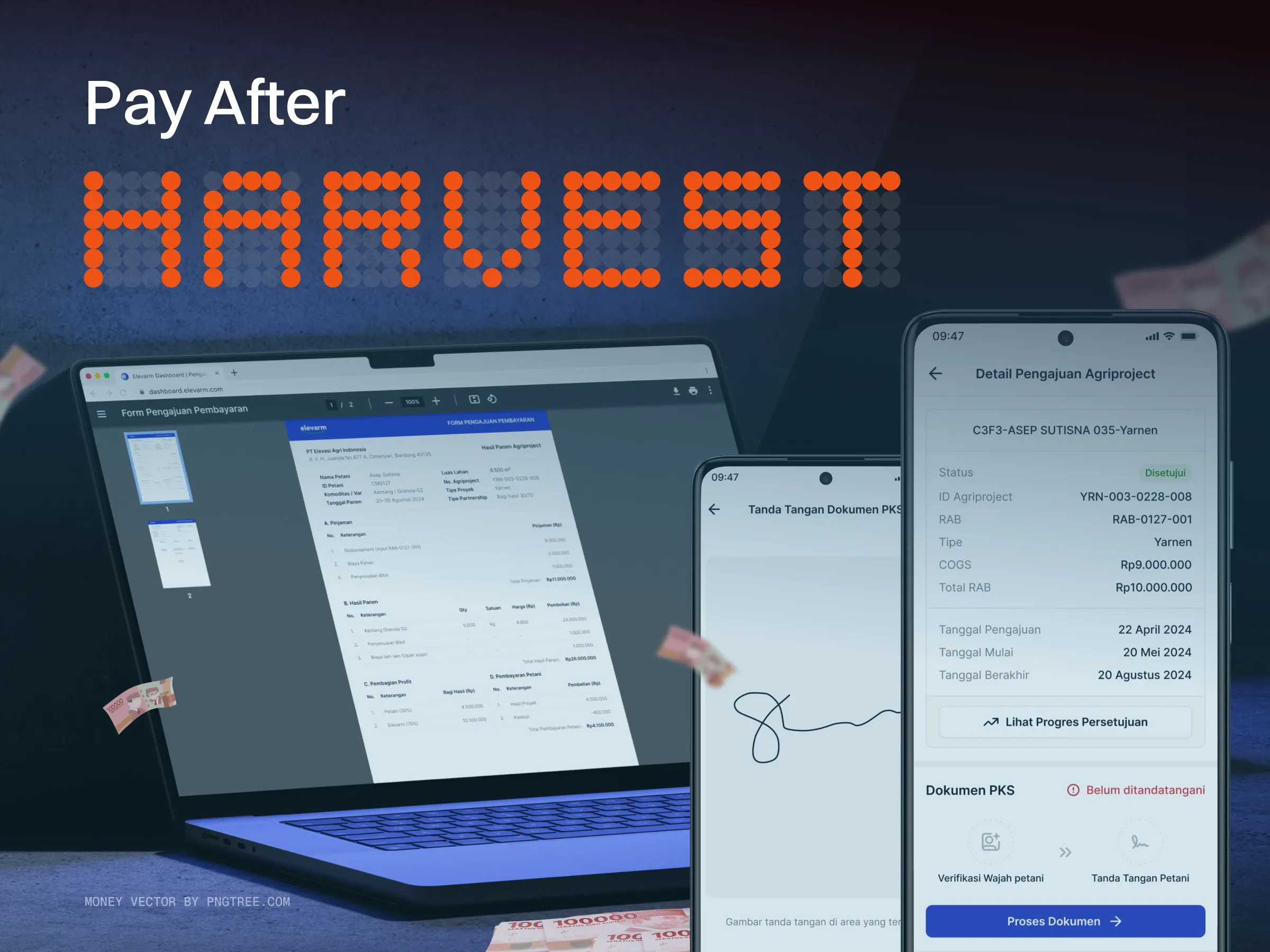
- 1.The contract. Once approved, the application shows a Dokumen PKSPKS · Perjanjian Kerja SamaThe cooperation agreement the farmer signs before inputs are delivered. (cooperation agreement) section marked not yet signed. The officer opens it with the farmer, takes the farmer's photo, captures their signature on the phone, and the agreement is signed. The signed PKS can be opened right away from the same screen.
- 2.Repayment status. During the season, the Agriproject card shows the total credit, how much has been drawn as farm inputs at AgripointsAgripointElevarm's local field hub where officers and farmers meet and harvests are collected., the remaining balance, and one status: Belum Mulai (approved, nothing drawn yet), Berjalan (running), Overdue (past the end date and not yet settled), or Selesai (settled).
- 3.The settlement (FPPFPP · Form Penyelesaian PembayaranThe farmer's settlement form, from harvest value and loan deductions to the final payment.). After harvest, the officer builds the FPP (Form Penyelesaian Pembayaran, the farmer's settlement form) step by step:
- Harvest value, disbursement, and cash advances are pulled in from records.
- Profit sharing: is there a sharing agreement? If yes, set the farmer's and Elevarm's percentages. If not, the profit goes to Elevarm, as agreed in the contract.
- Loan items: harvest costs, seed adjustments, earlier debts, and other costs, each as its own line.
- Farmer payments: seed adjustments and other items owed to the farmer.
- Summary: total loan, total harvest value, profit split, and the final payment = the farmer's profit share minus cash advances.
A confirmation step asks “Is the data correct?” before the FPP is finalized. The generated document is signed in four roles: submitted by the Field Officer, acknowledged by the Farming Project Coordinator, verified by the Agri-Project Manager, and confirmed by the farmer. Once the FPP is complete, the Agriproject is settled.
Face check before signing
Before the farmer signs, the app checks their face with the camera. The frame fills once the face is in position.
Signed on the phone
The farmer signs in the app, and the signed PKS opens right away from the same screen.
Face check before signing
Before the farmer signs, the app checks their face with the camera. The frame fills once the face is in position.
Signed on the phone
The farmer signs in the app, and the signed PKS opens right away from the same screen.
Building the settlement
After harvest, the officer sets the profit share and adds each loan item and payment owed to the farmer.
A payment the farmer can follow
A summary shows every step from harvest value to final payment. After a final check, the result appears on the harvest page.
Building the settlement
After harvest, the officer sets the profit share and adds each loan item and payment owed to the farmer.
A payment the farmer can follow
A summary shows every step from harvest value to final payment. After a final check, the result appears on the harvest page.
A deliberate “no”: no single score that decides for you
We could have turned the questionnaire into one automatic number that approves or rejects, and decided against it. The score sets the credit limit, but whether a project gets financed stays with people: the questionnaire and the bureau result sit side by side, with a written recommendation and named approvers. Financing a farmer is a judgment call, so the design gives people evidence and keeps the decision with them.
Impact
Parts of this flow are designed and handed off but not yet released, so there's no usage data for them. Below are the design outcomes and the program the flow supports.
Design outcomes
- One path across two products: application, scoring, and contract in Elevarm App, assessment and approval in Elevarm Dashboard, with the same status in both
- Auto-filled applications: plots and commodities come from the approved budget, and harvest dates from the planting date
- Document check before scoring, per farmer and per plot, with drafts instead of dead ends
- A 7-part field questionnaire, a 360° assessment, and a bureau check behind every credit decision
- Approval rules by budget size, up to three management reviewers, approval by email, and a full timeline
- A settlement the farmer can follow, from harvest value to final payment, signed by four roles
The program it supports (context, not design claims)
According to the Impact Report 2024:
- farmers' reliance on informal loans fell from 30.67% to 10.16%
- Elevarm covered 62.5% of farmers' working capital per cycle on average
- working capital needed per cycle fell 22.5%
- IDR 21 billion was disbursed to farmers in 2024
According to Elevarm's Product Manager:
- 200+ Agriprojects are financed a year
- 92.4% of loans issued in 2024–2025 were repaid (7.6% more than 90 days overdue)
- time from budget plan (RAB) to project approval went from about 2 weeks to a 5-day service level
Elevarm also partnered with Rabo Foundation, SCALA, and Amartha on a US$1 million farmer financing program in the form of farm inputs (Elevarm on Instagram).
Reflection
What I learned
- Design the handoffs between roles. The hardest part was deciding which role owns which step, and making sure the next role sees what the previous one did.
- Field knowledge is credit data. Structuring what officers already know turned informal judgment into evidence an approver can read.
- Show every line of the calculation. A final payment means more to a farmer when every line before it is visible.
What I'd do differently
I'd test the settlement screen with farmers directly, as well as with officers, because the farmer is the one who has to accept the final number.
What's next
- Track which questionnaire answers best predict on-time settlement, and simplify the rest.
- Let farmers keep a copy of each signed settlement, shared by their Field Officer, so they have a record of every season.
Next case study
Keep reading